Product photo coming soon
ASUS IoTASUS AISVision 2.0
AI vision tool for training custom recognition models on site and deploying them fast.
- Classification, segmentation, detection, anomaly
- No-code labelling and training
- On-premises inference

Image recognition and data analysis run right at the equipment — fast response without sending data to the cloud.
INIKI sells and deploys ASUS AI solutions with hands-on experience — on-site installation, model training and integration with existing equipment.
AI vision tool for training custom recognition models on site and deploying them fast.
AI workplace safety platform that recognises safety events and notifies the right people.
Classification, segmentation, detection and anomaly models recognise defects and work states.
Detect smoke, fire, intrusion and missing PPE and notify automatically.
Integrate warning lights and PA systems and record every event for audits.
Help technicians find the right troubleshooting steps and cut downtime.
Analyse vibration at the machine to catch rotating-equipment faults early.
Low-latency inference on site for immediate action.
Images and process data remain on your network.
No-code model training adapts quickly to site needs.
Each has its place. Classic AOI still suits fixed specifications and precise dimensional measurement; AI shines when defects vary and backgrounds are complex.
| Traditional AOI | AI deep-learning inspection | |
|---|---|---|
| How it decides | Rules and fixed parameters | Neural networks learn features and infer |
| Best for | High volume, fixed specs, absolute dimensions | High mix (with anomaly detection trained on good parts), unstructured defects, complex backgrounds |
| False rejects (overkill) | High; sensitive to lighting | Lower; tolerant of variation |
| Escapes (underkill) | Misses defects that were never defined | Catches complex, non-standard anomalies |
| Changeover | Days to weeks of re-tuning and programming | Hours to days with transfer learning |
Garbage in, garbage out. Optical design often matters more than the model itself.
Bright-field for outlines and presence checks; dark-field makes scratches and fine marks light up.
Global shutter for high-speed lines to avoid distortion; rolling shutter for stop-and-go.
Chosen by field of view, working distance and depth of field to fit the machine.
The smallest defect should span 3–5 pixels for stable AI detection; camera resolution is sized from that.
On a line with 98% yield, an AI that passes everything still scores 98% accuracy while every defect escapes. We accept systems on two line-relevant metrics.
The share of defects caught. Critical defects usually require 99% or more.
The share of good parts rejected. Too high overwhelms manual review; below 5% is a common target.
Train on good parts only and flag anything that deviates, without collecting many defects.
Generative AI and rotation, contrast and noise augmentation make the most of rare defects.
Borderline images from the line are fed back for retraining, so the model keeps improving.
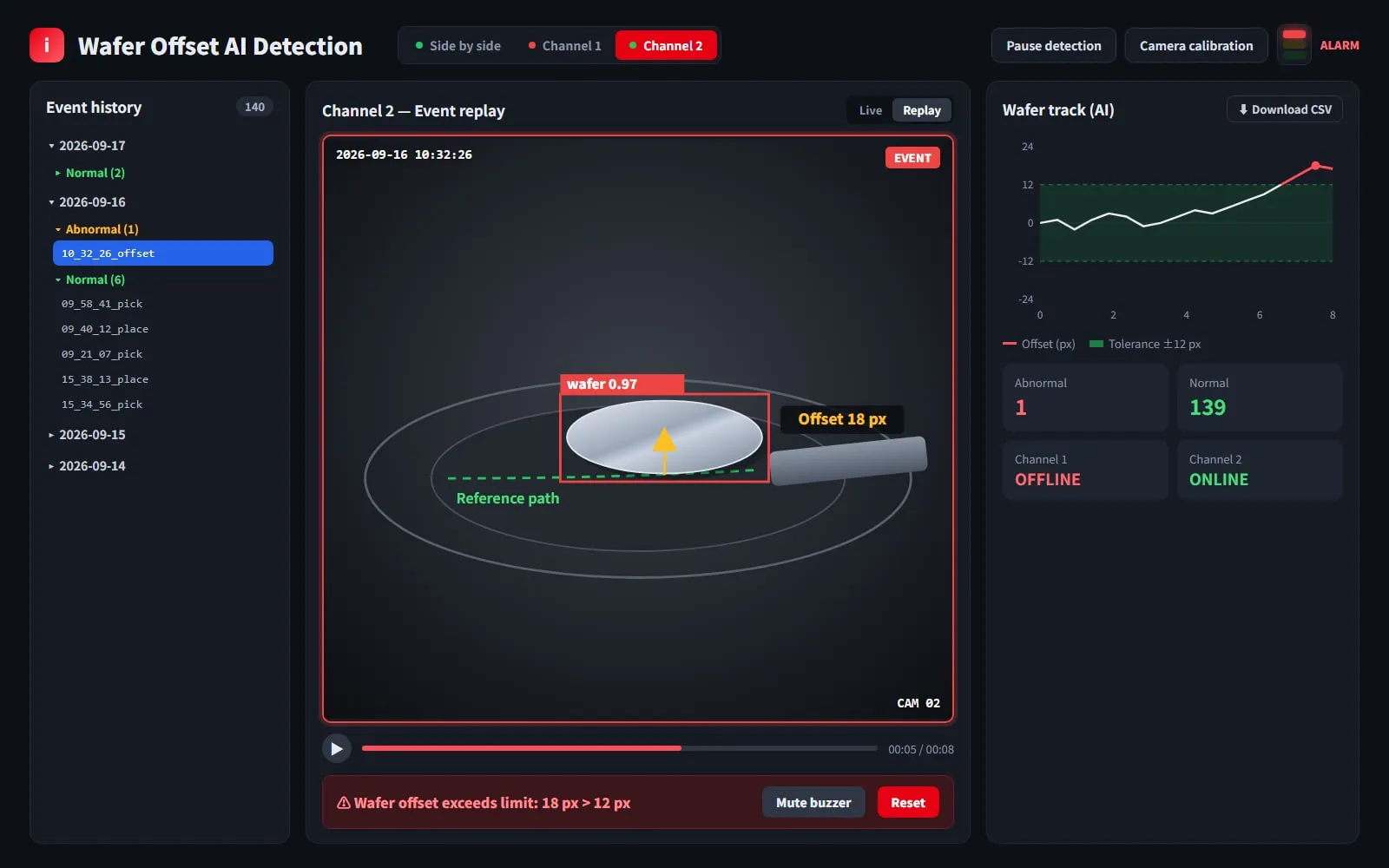
Two cameras and AI image recognition track each wafer's path inside a plating tool in real time. When the offset exceeds the limit, a stack light, buzzer and relay trigger instantly, and every event's video and track data are kept.
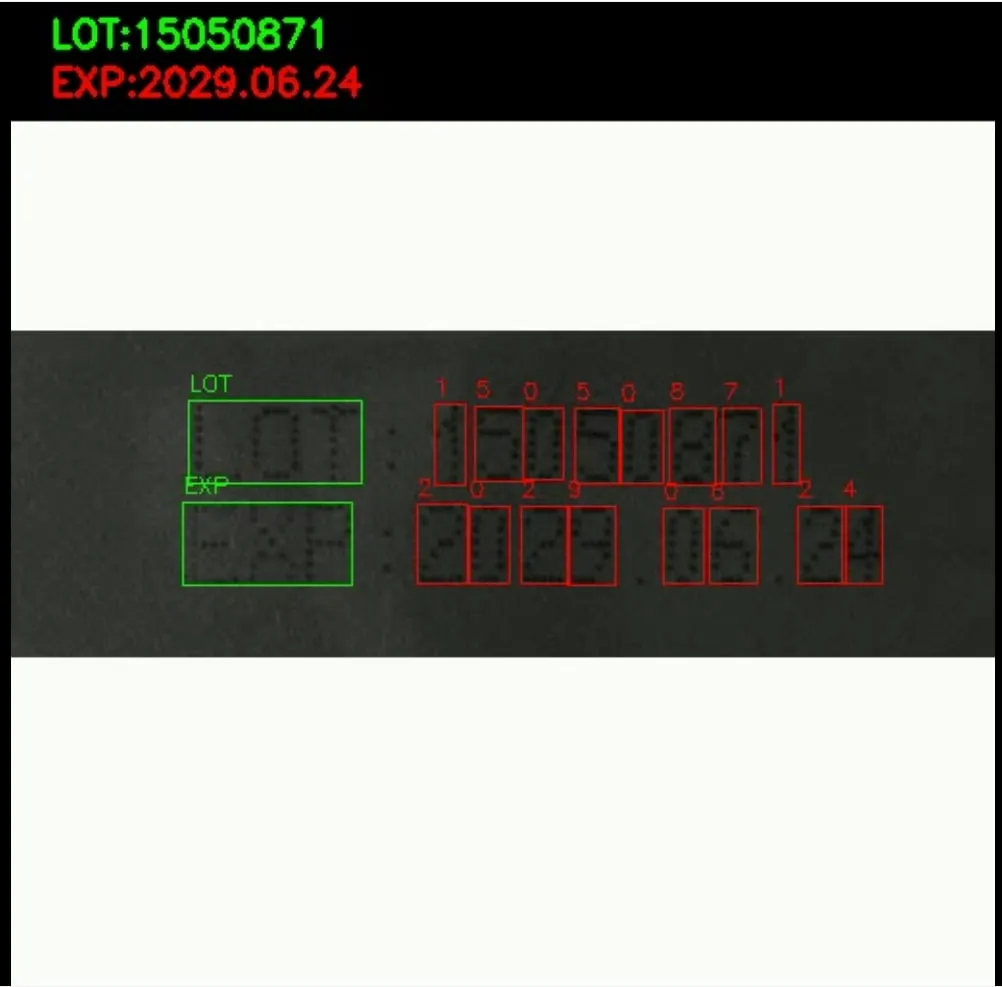
AI image recognition replaced the existing reader to inspect lot and expiry printing on every foil pouch inline, across light and dark packaging, triggering existing machine signals on failures with no re-tuning after installation.
Tell us what you want to recognise and we will help plan the deployment.